Showing posts with label Baseball. Show all posts
Showing posts with label Baseball. Show all posts
Sunday, March 31, 2013
Baseball Season
"It is played everywhere: in parks and playgrounds, prison yards, in back alleys and farmers’ fields; by small boys and old men, raw amateurs and millionaire professionals. It is a leisurely game that demands blinding speed; the only game in which the defense has the ball. It follows the seasons, beginning each year with the fond expectancy of springtime and ending with the hard facts of autumn.
Americans have played baseball for more than 200 years; while they conquered a continent, warred with each other and with enemies abroad, struggled over labor and civil rights, and with the meaning of freedom.
At its heart lie mythic contradictions: a pastoral game born in crowded cities, an exhilarating democratic sport that tolerates cheating, and has excluded as many as it has included. A profoundly conservative game that often manages to be years ahead of its time. It is an American Odyssey that links sons and daughters to fathers and grandfathers, and it reflects a host of age-old American tensions; between workers and owners, scandal and reform, the individual and the collective.
It is a haunted game in which every player is measured with the ghosts of those who have gone before. Most of all it is about time and timelessness, speed and grace, failure and loss, imperishable hope, and coming home.
The game’s greatest figures have come from everywhere: coal mines and college campuses, city slums and country crossroads. A brawling Irish immigrant’s son [John McGraw] who for more than half a century preached a rough and scrambling brand of baseball in which anything went so as long victory was achieved; and his favorite player, a college-educated right-hander [Christy Mathewson] so uniformly virtuous that millions of schoolboys worshipped him as The Christian Gentleman.
A mill hand who could neither read nor write [Joe Jackson] who might have been one of the game's greatest heroes if temptation had not proved too great. A flamboyant federal judge [Kenesaw Mountain Landis] who at first saved baseball from a scandal that threatened to destroy it, but later became an implacable enemy of reform.
A miner’s son [Mickey Mantle] from Commerce, Oklahoma, who made himself the game’s most powerful switch-hitter despite 17 seasons of ceaseless pain. A tight-fisted Methodist [Branch Rickey], ‘a cross’, one sportswriter said, ‘between a statistician and an evangelist’, who profoundly changed the game twice. And there were those whose true greatness was never fully measured because of the stubborn prejudice that permeated the nation and its favorite game.
Two of baseball's best began life in rural Georgia: A swift and savage competitor [Ty Cobb] who may have been the greatest player of all time, but whose uncontrollable rage in the end made him more enemies than friends; and another no less fierce competitor [Jackie Robinson] who, because he managed to hold his temper, made professional baseball a truly national pastime more than a century after it was born.
And then there was the Baltimore saloonkeeper’s turbulent son [Babe Ruth], who became the best-known and best-loved athlete in American history." - Ken Burns' Baseball


Sunday, October 21, 2012
Moran and the Reds
A photograph from the American Memory collection through the Library of Congress.
The photograph was taken by the Chicago Daily News in 1919. Patrick Moran, then manager of the Reds, sits closest to the camera in the middle of the frame. The summary of the photo suggests that the photo may have been taken during the 1919 World Series between the Cincinnati Reds and the Chicago White Sox. Baseball fans would remember this Series as the infamous "Black Sox Scandal." Immortalized in numerous books and films like, Field of Dreams and Eight Men Out.
 | ||
| Chicago Daily News negatives collection, DN-0003451. Courtesy of Chicago History Museum. |
Saturday, October 20, 2012
Home Plate, Leaving and Returning
I recently purchased Baseball and Philosophy as part of the Pop Culture and Philosophy series. Other titles include, Seinfeld and Philosophy, The Simpsons and Philosophy, The Sopranos and Philosophy, etc.
Though I'm only a few pages in, one particular passage struck me about the concept of home plate.
This selection comes from, "There's No Place Like Home!" by Joe Kraus.
"The goal is to get 'home', and yet, every batter starts off at home. As soon as you walk up to face the pitcher, you're standing at the place you're eventually trying to reach. It's not hard to imagine Jerry Seinfeld asking the question, 'So, why leave? Why not just stay at home in the first place and forget about first, second, and third bases?' The answer, of course, is that 'home' in baseball doesn't count until you've left it...Put differently, home doesn't become meaningful until you have experienced the risk that lies in front of it. Homer told us, 'home is all the sweeter when you've braved adventures to get back to it.' (page 10)
Though I'm only a few pages in, one particular passage struck me about the concept of home plate.
This selection comes from, "There's No Place Like Home!" by Joe Kraus.
"The goal is to get 'home', and yet, every batter starts off at home. As soon as you walk up to face the pitcher, you're standing at the place you're eventually trying to reach. It's not hard to imagine Jerry Seinfeld asking the question, 'So, why leave? Why not just stay at home in the first place and forget about first, second, and third bases?' The answer, of course, is that 'home' in baseball doesn't count until you've left it...Put differently, home doesn't become meaningful until you have experienced the risk that lies in front of it. Homer told us, 'home is all the sweeter when you've braved adventures to get back to it.' (page 10)
Friday, October 19, 2012
Patrick Moran Baseball Card (1912)
 |
| 1912 Patrick Moran Baseball Card |
The back of Moran's card reads,
"Paddy Moran, catcher for the Philadelphia Nationals, is 36 years of age and started out as a professional in 1897 with the Lyons team of the New York State League. He joined the Boston Nationals in 1901 and was a member of that team for five years. In 1905 he figured in a trade and landed with the Chicago team just in time to share in the prosperity of the Cubs, who won three pennants and two world's championships in the next four years. Moran was traded to the Philadelphia club in 1910 and his specialty now is coaching young pitchers. He batted .184 and fielded .984 in 1911."
Thursday, October 18, 2012
Burkett and Moran
Through the American Memory collection through the Library of Congress, I found an early baseball card of Jesse Burkett. The set is known as the 1909 T204 Ramly Cigarettes set.
There were 121 cards issues in this set and the LoC has 56 of them in their online digital collection. What makes Burkett's presence in this set interesting is the fact that the Worcester Busters (the team he managed from 1906-1913) was a minor league team. All of the other teams featured in this set are from the major leagues.
Though not found in the LoC's collection, but elsewhere online, another familiar face was featured in this set.
Fitchburg native Patrick Moran (seen here as P.J. Moran) was catching for the Chicago Cubs in 1909. Notice the square gold background in Moran's card, rather than the oval in Burkett's. The Cubs finished in 2nd place in 1909, winning 104 games.
 |
| 1909 Jesse Burkett Baseball Card |
Though not found in the LoC's collection, but elsewhere online, another familiar face was featured in this set.
 |
| 1909 Patrick Moran Baseball Card |
Sunday, August 12, 2012
Jim Thorpe, Almost in Fitchburg Colors
The 2012 London Olympics has captured the attention of most Americans for the past few weeks. Sure, some athletes and sports are more popular than others (Michael Phelps/Swimming, Misty May-Treanor/Women's Beach Volleyball) but the Olympics are also the penultimate stage for athletic achievements. Each Olympics features many World Records being set and broken and some even set and broken again. It is a natural obsession to be awed in the continual 'one-upping' of physical efforts.
Following a suspension from the Hartford Senators, there were strong efforts from Fitchburg club owner, John Kiernan, to entice Thorpe to come to the mill city. The efforts, unfortunately, were not enough for Hartford, who ended up releasing Thorpe to Worcester. The Greatest Athlete in the World hit .344 in his final year of minor league ball, at age 35.
One of my favorite topics has been the one hundred year anniversary of Jim Thorpe's gold medal victories in the pentathlon and decathlon.
It was because of these two medals that King Gustav V of Sweden was rumored to have told Thorpe, "You, sir, are the greatest athlete in the world."
 |
| Fig. 1: Jim Thorpe at the 1912 Olympics in Stockholm, Sweden |
A quick glance at the athletic resume of Thorpe reveals his natural prowess at nearly every popular sport: football, baseball and even basketball, in addition to his Olympic pursuits. It was his baseball years that had me naturally intrigued.
Thorpe played professional baseball primarily with the New York Giants, but also played a year with the Cincinnati Reds and Boston Braves. His last year at the major league level was 1919, the same year as the infamous Black Sox Scandal.
According to Baseball-Reference, Thorpe played for three minor league teams in the 1922 season: the Portland Beavers of the Pacific Coast League, as well as the Hartford Senators and the Fitchburg/Worcester Boosters of the Eastern League. The 1922 season would prove to be the final season for Thorpe's baseball career.
 |
| Fig. 2: Sports headline from June 23rd, 1922 issue of the Fitchburg Sentinel |
Following a suspension from the Hartford Senators, there were strong efforts from Fitchburg club owner, John Kiernan, to entice Thorpe to come to the mill city. The efforts, unfortunately, were not enough for Hartford, who ended up releasing Thorpe to Worcester. The Greatest Athlete in the World hit .344 in his final year of minor league ball, at age 35.
Ten years removed from his Olympics performance, Thorpe was still a draw to the towns and cities he visited. It is still a spectacle to see some of yesterday's athletes in the flesh, or better yet, in a smaller setting. This past May, I went to the opening night of the Worcester Tornadoes primarily to see Jose Canseco. A few years ago, incidentally, at another Tornadoes game I attended, Eric Gagne, was the starting pitcher for the Quebec Capitales. Gagne scrubbed out of his MLB career with admissions to steroid abuse after a spectacular fall from grace. It may be the stuff of legends and hearsay, but it has often been claimed that "Shoeless" Joe Jackson played amateur baseball under a pseudonym after being banned from the major leagues.
It's been said that Thorpe did not manage his money and fame very well and was constantly in need of extra cash. The same can probably be said of both Canseco and Gagne, playing in much smaller market venues. Whatever their motives or reasons for returning to the game, being able to see your heroes on your turf, is still magical. I'm sure the folks of Fitchburg were more than excited to see the greatest athlete in the world grace their field, even if the stakes were not so high.
 |
| Fig. 3: Jim Thorpe batting for the New York Giants |
Wednesday, August 8, 2012


Thursday, April 26, 2012
Happy Birthday, Fenway
Last Friday, I was very fortunate enough to be at Fenway Park for their 100th Birthday celebration.
At first, I was interested in the game, the Yankees coming to Fenway for the first time in 2012 season.
I was more concerned with seeing our current team battle in a symbolic representation of our nearly 100 year rivalry.
I was not at all concerned with the pre-game ceremonies. As a historian, I was cynically assuming that it would be a massive, commercialized pomp and circumstance over discounted beer and historical ripoff gag gifts. Luckily, for me, I was proven wrong. Dead wrong.
The pre-game ceremony began very quietly with the Yankees leaving the field following batting practice. The Red Sox grounds crew disassembled the batting cages and the field was cleared. Then after a very brief introduction by the public announcement system, silence fell over the field.
Using the center field garage door as the stand-in for Ray Kinsella's Iowa corn fields, Red Sox alumni from bygone years stepped forward to cheering fans and took their position on the field. The main video screen in center field showed a live feed of the player stepping into center field while another screen displayed their name, picture and years of wearing a Red Sox uniform.
Of the dozens of players introduced, the most poignant of all was first baseman Bill Buckner.
The legacy of Bill Buckner needs no explanation here, but in a gesture of gratitude, he was the first first baseman introduced and was able to walk his way to first base before any other player was introduced. This was one of the first players to receive a standing ovation and it was clearly an emotional experience for both Buckner and the fans. Being twenty-six years removed from his infamous play, the demons appeared to have been kept at bay. For the Red Sox have won the World Series in 2004 and 2007, therefore lifting any sort of "blame" on Buckner. He has made his peace with the fans and the media since those many years ago. The romance of baseball is too hard to eliminate and forgive me while I indulge for only a short while.
Watching Bill Buckner emerge from the symbolic corn fields of Fenway Park and take his position at first base reminded me of Terence Mann's (played by James Earl Jones) speech in Field of Dreams,
"The one constant through all the years, Ray, has been baseball. America has rolled by like an army of steamrollers. It has been erased like a blackboard, rebuilt and erased again. But baseball has marked the time. This field, this game: it's a part of our past, Ray. It reminds of us of all that once was good and it could be again."
If Buckner's career being immortalized by one groundball is a tragedy, then I propose that the ultimate redemption came when he could take the field at Fenway Park. Not to throw out a first pitch or hold a championship banner but to walk to first base and be engulfed in applause.
As each player walked onto the field, some more famous and popular than others, some younger, older, able-bodied and wheelchair / walker accompanied, they all shared that bond of being part of 100 years of history. Fenway Park was the ultimate time capsule yesterday during this pre-game ceremony. As fans, we were on hand to see our ghosts of the past take the field. We of course recalled those who were not able to be in attendance, but those who were became immortalized. It was surely no accident that Fenway Park decided to choreograph this ceremony with homage to Field of Dreams. For Fenway has remained constant throughout the years. The field is part of our past, it reminds us of all that once was good and it could be again.
If there were any somber moments during the ceremony they may be found in the complete silence that took over fans. Save for the cheering and applause for each player, there was no talking. The only words heard were "Wow", "My gosh", "I can't believe it." Some of the men sitting near me were fighting back tears of memory and I can honestly say that more than once I could hear the quiet, broken-voiced whispers of, "I wish my father were here."
If baseball is that ultimate American pastime, that ultimate connection between yesterday and today, and that ultimate connection between families, friends and neighbors, then Friday, April 2oth was its ultimate day.
At first, I was interested in the game, the Yankees coming to Fenway for the first time in 2012 season.
I was more concerned with seeing our current team battle in a symbolic representation of our nearly 100 year rivalry.
I was not at all concerned with the pre-game ceremonies. As a historian, I was cynically assuming that it would be a massive, commercialized pomp and circumstance over discounted beer and historical ripoff gag gifts. Luckily, for me, I was proven wrong. Dead wrong.
The pre-game ceremony began very quietly with the Yankees leaving the field following batting practice. The Red Sox grounds crew disassembled the batting cages and the field was cleared. Then after a very brief introduction by the public announcement system, silence fell over the field.
Using the center field garage door as the stand-in for Ray Kinsella's Iowa corn fields, Red Sox alumni from bygone years stepped forward to cheering fans and took their position on the field. The main video screen in center field showed a live feed of the player stepping into center field while another screen displayed their name, picture and years of wearing a Red Sox uniform.
Of the dozens of players introduced, the most poignant of all was first baseman Bill Buckner.
 |
| Fig. 1: Bill Buckner takes the field at Fenway Park. |
 |
| Fig. 2: Red Sox Alumni walking back into the symbolic corn fields of Fenway Park. |
The legacy of Bill Buckner needs no explanation here, but in a gesture of gratitude, he was the first first baseman introduced and was able to walk his way to first base before any other player was introduced. This was one of the first players to receive a standing ovation and it was clearly an emotional experience for both Buckner and the fans. Being twenty-six years removed from his infamous play, the demons appeared to have been kept at bay. For the Red Sox have won the World Series in 2004 and 2007, therefore lifting any sort of "blame" on Buckner. He has made his peace with the fans and the media since those many years ago. The romance of baseball is too hard to eliminate and forgive me while I indulge for only a short while.
Watching Bill Buckner emerge from the symbolic corn fields of Fenway Park and take his position at first base reminded me of Terence Mann's (played by James Earl Jones) speech in Field of Dreams,
"The one constant through all the years, Ray, has been baseball. America has rolled by like an army of steamrollers. It has been erased like a blackboard, rebuilt and erased again. But baseball has marked the time. This field, this game: it's a part of our past, Ray. It reminds of us of all that once was good and it could be again."
If Buckner's career being immortalized by one groundball is a tragedy, then I propose that the ultimate redemption came when he could take the field at Fenway Park. Not to throw out a first pitch or hold a championship banner but to walk to first base and be engulfed in applause.
As each player walked onto the field, some more famous and popular than others, some younger, older, able-bodied and wheelchair / walker accompanied, they all shared that bond of being part of 100 years of history. Fenway Park was the ultimate time capsule yesterday during this pre-game ceremony. As fans, we were on hand to see our ghosts of the past take the field. We of course recalled those who were not able to be in attendance, but those who were became immortalized. It was surely no accident that Fenway Park decided to choreograph this ceremony with homage to Field of Dreams. For Fenway has remained constant throughout the years. The field is part of our past, it reminds us of all that once was good and it could be again.
If there were any somber moments during the ceremony they may be found in the complete silence that took over fans. Save for the cheering and applause for each player, there was no talking. The only words heard were "Wow", "My gosh", "I can't believe it." Some of the men sitting near me were fighting back tears of memory and I can honestly say that more than once I could hear the quiet, broken-voiced whispers of, "I wish my father were here."
If baseball is that ultimate American pastime, that ultimate connection between yesterday and today, and that ultimate connection between families, friends and neighbors, then Friday, April 2oth was its ultimate day.
Sunday, April 1, 2012
Patrick Moran Baseball Card (1 of 5)
 |
| Fig. 1: 1911 Patrick Moran baseball card |
 |
| Fig. 2: Backside of the 1911 Patrick Moran baseball card |
Through the same collection in the Library of Congress, this was the first of five baseball cards with Patrick Moran.
The backside of the card reads:
"PATRICK J. MORAN
Patrick J. Moran, who caught for the Philadelphia Nationals in 1910, came to that team from the Cubs, with whom he had played four seasons. Before that he had been with the Boston Nationals, and in his last year with them, in 78 games behind the bat, led all the catchers in the National League, with the high average of .986.
In 1910, his average for the year was again the highest recorded for any National League backstop."
John James "Nixey" Callahan Baseball Card
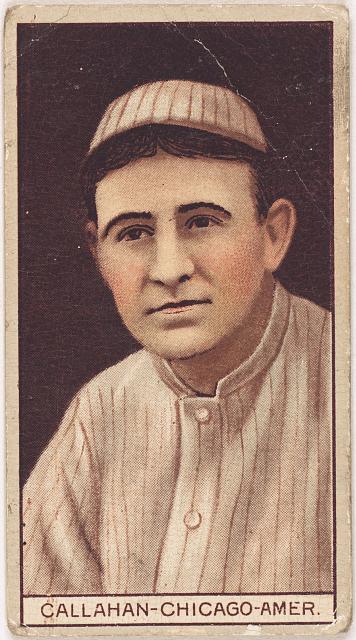 |
| Fig. 1: "Callahan-Chicago-Amer." A 1912 baseball card of "Nixey" Callahan |
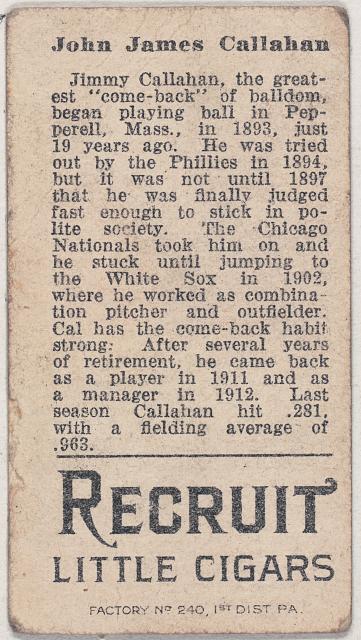 |
| Fig. 2: Backside of the "Nixey" Callahan baseball card. |
The American Memory Project of the Library of Congress has a great collection of baseball cards from 1887-1914. I found this one of "Nixey" Callahan. It is the only card of him in their collection, but there may be others.
The backside of the card reads:
"John James Callahan
Jimmy Callahan, the greatest 'come-back' of balldom, began playing ball in Pepperell, Mass., in 1893, just 19 years ago. He was tried out by the Phillies in 1894, but it was not until 1897 that he was finally judged fast enough to stick in polite society. The Chicago Nationals took him on and he stuck until jumping to the White Sox in 1902, where he worked as combination pitcher and outfielder. Cal has the come-back habit strong. After several years of retirement, he came back as a player in 1911 and as a manager in 1912. Last season Callahan hit .281, with a fielding average of .963."
New Project
After nearly three years of studying the architecture of H.M. Francis in Fitchburg, I'm moving on to a new research topic.
The work of the Francis firm will always be something I'll have a fascination in, but I feel it is necessary to begin working on another project.
Starting in May, I'm going to begin researching baseball teams in Fitchburg. Baseball was a very big part of my childhood as well as the lives of countless other young boys in America. I have very strong, emotional ties to Little League Baseball, Major League Baseball and even the minor leagues. The intricacy, chess match-like qualities of baseball have always fascinated me to a great degree. I enjoy the silence of the game. The pops of the bat, the skidding of the grass, the hurried footsteps of the batters as well as the smell of fresh cut grass, and the heat of the afternoon sun all have a special place in my heart. Through all of the events of a baseball game, the voices of the players are often subdued, and muted to spectators. You have to rely on umpire signals, player body language and dirt kicking to understand what the players go through. Today's television coverage will sometimes feature a player wearing a microphone through warm-ups or even in the dugout but those invasions taint the game for me. It's much more powerful to be a casual onlooker interpreting the grimaces and celebrations than a fly on the wall. I've attended numerous baseball games in my life, whether it's professional (Red Sox), minor league (Spinners, Sea Dogs, Paw Sox) or even amateur (Tornadoes) and no matter where my seat was, I rarely heard the dugout banter or discussions amongst players.
I much prefer that atmosphere, that wall between the spectator and athlete, the fan and the superstar.
My research is a bit open-ended at this point. I haven't devoted much time to preparing an outline towards a thesis or working goal, other to simply learn. I decided upon Fitchburg baseball because it is my current home but also because baseball at its infancy, as well as during the "deadball era" had many social and cultural implications on a community.
Two players that I want to focus on, in regards to their relationships to Fitchburg are Patrick Moran and "Nixey" Callahan.
Both grew up in Fitchburg, playing on local youth teams but later made it to the American and National Leagues.
Patrick Moran was manager of the Cincinnati Reds in 1919 when the Chicago White Sox threw the World Series and were blacklisted from baseball. It's also been said that Callahan threw the first no-hitter in the American League.
Though their major league exploits are fairly well-documented in various encyclopedias and online databases, I'm interested in seeing Moran and Callahan at a more local level before they made it to the big stage.
As the school year winds down and summer begins, I'll continue to post my research findings and get back into old grooves.
The work of the Francis firm will always be something I'll have a fascination in, but I feel it is necessary to begin working on another project.
Starting in May, I'm going to begin researching baseball teams in Fitchburg. Baseball was a very big part of my childhood as well as the lives of countless other young boys in America. I have very strong, emotional ties to Little League Baseball, Major League Baseball and even the minor leagues. The intricacy, chess match-like qualities of baseball have always fascinated me to a great degree. I enjoy the silence of the game. The pops of the bat, the skidding of the grass, the hurried footsteps of the batters as well as the smell of fresh cut grass, and the heat of the afternoon sun all have a special place in my heart. Through all of the events of a baseball game, the voices of the players are often subdued, and muted to spectators. You have to rely on umpire signals, player body language and dirt kicking to understand what the players go through. Today's television coverage will sometimes feature a player wearing a microphone through warm-ups or even in the dugout but those invasions taint the game for me. It's much more powerful to be a casual onlooker interpreting the grimaces and celebrations than a fly on the wall. I've attended numerous baseball games in my life, whether it's professional (Red Sox), minor league (Spinners, Sea Dogs, Paw Sox) or even amateur (Tornadoes) and no matter where my seat was, I rarely heard the dugout banter or discussions amongst players.
I much prefer that atmosphere, that wall between the spectator and athlete, the fan and the superstar.
My research is a bit open-ended at this point. I haven't devoted much time to preparing an outline towards a thesis or working goal, other to simply learn. I decided upon Fitchburg baseball because it is my current home but also because baseball at its infancy, as well as during the "deadball era" had many social and cultural implications on a community.
Two players that I want to focus on, in regards to their relationships to Fitchburg are Patrick Moran and "Nixey" Callahan.
Both grew up in Fitchburg, playing on local youth teams but later made it to the American and National Leagues.
Patrick Moran was manager of the Cincinnati Reds in 1919 when the Chicago White Sox threw the World Series and were blacklisted from baseball. It's also been said that Callahan threw the first no-hitter in the American League.
Though their major league exploits are fairly well-documented in various encyclopedias and online databases, I'm interested in seeing Moran and Callahan at a more local level before they made it to the big stage.
As the school year winds down and summer begins, I'll continue to post my research findings and get back into old grooves.
Subscribe to:
Posts (Atom)