 | ||
| Chicago Daily News negatives collection, DN-0003451. Courtesy of Chicago History Museum. |
Showing posts with label Fitchburg History. Show all posts
Showing posts with label Fitchburg History. Show all posts
Sunday, October 21, 2012
Moran and the Reds
A photograph from the American Memory collection through the Library of Congress.
The photograph was taken by the Chicago Daily News in 1919. Patrick Moran, then manager of the Reds, sits closest to the camera in the middle of the frame. The summary of the photo suggests that the photo may have been taken during the 1919 World Series between the Cincinnati Reds and the Chicago White Sox. Baseball fans would remember this Series as the infamous "Black Sox Scandal." Immortalized in numerous books and films like, Field of Dreams and Eight Men Out.


Friday, October 19, 2012
Patrick Moran Baseball Card (1912)
 |
| 1912 Patrick Moran Baseball Card |
The back of Moran's card reads,
"Paddy Moran, catcher for the Philadelphia Nationals, is 36 years of age and started out as a professional in 1897 with the Lyons team of the New York State League. He joined the Boston Nationals in 1901 and was a member of that team for five years. In 1905 he figured in a trade and landed with the Chicago team just in time to share in the prosperity of the Cubs, who won three pennants and two world's championships in the next four years. Moran was traded to the Philadelphia club in 1910 and his specialty now is coaching young pitchers. He batted .184 and fielded .984 in 1911."
Thursday, October 18, 2012
Burkett and Moran
Through the American Memory collection through the Library of Congress, I found an early baseball card of Jesse Burkett. The set is known as the 1909 T204 Ramly Cigarettes set.
There were 121 cards issues in this set and the LoC has 56 of them in their online digital collection. What makes Burkett's presence in this set interesting is the fact that the Worcester Busters (the team he managed from 1906-1913) was a minor league team. All of the other teams featured in this set are from the major leagues.
Though not found in the LoC's collection, but elsewhere online, another familiar face was featured in this set.
Fitchburg native Patrick Moran (seen here as P.J. Moran) was catching for the Chicago Cubs in 1909. Notice the square gold background in Moran's card, rather than the oval in Burkett's. The Cubs finished in 2nd place in 1909, winning 104 games.
 |
| 1909 Jesse Burkett Baseball Card |
Though not found in the LoC's collection, but elsewhere online, another familiar face was featured in this set.
 |
| 1909 Patrick Moran Baseball Card |
Sunday, August 12, 2012
Jim Thorpe, Almost in Fitchburg Colors
The 2012 London Olympics has captured the attention of most Americans for the past few weeks. Sure, some athletes and sports are more popular than others (Michael Phelps/Swimming, Misty May-Treanor/Women's Beach Volleyball) but the Olympics are also the penultimate stage for athletic achievements. Each Olympics features many World Records being set and broken and some even set and broken again. It is a natural obsession to be awed in the continual 'one-upping' of physical efforts.
Following a suspension from the Hartford Senators, there were strong efforts from Fitchburg club owner, John Kiernan, to entice Thorpe to come to the mill city. The efforts, unfortunately, were not enough for Hartford, who ended up releasing Thorpe to Worcester. The Greatest Athlete in the World hit .344 in his final year of minor league ball, at age 35.
One of my favorite topics has been the one hundred year anniversary of Jim Thorpe's gold medal victories in the pentathlon and decathlon.
It was because of these two medals that King Gustav V of Sweden was rumored to have told Thorpe, "You, sir, are the greatest athlete in the world."
 |
| Fig. 1: Jim Thorpe at the 1912 Olympics in Stockholm, Sweden |
A quick glance at the athletic resume of Thorpe reveals his natural prowess at nearly every popular sport: football, baseball and even basketball, in addition to his Olympic pursuits. It was his baseball years that had me naturally intrigued.
Thorpe played professional baseball primarily with the New York Giants, but also played a year with the Cincinnati Reds and Boston Braves. His last year at the major league level was 1919, the same year as the infamous Black Sox Scandal.
According to Baseball-Reference, Thorpe played for three minor league teams in the 1922 season: the Portland Beavers of the Pacific Coast League, as well as the Hartford Senators and the Fitchburg/Worcester Boosters of the Eastern League. The 1922 season would prove to be the final season for Thorpe's baseball career.
 |
| Fig. 2: Sports headline from June 23rd, 1922 issue of the Fitchburg Sentinel |
Following a suspension from the Hartford Senators, there were strong efforts from Fitchburg club owner, John Kiernan, to entice Thorpe to come to the mill city. The efforts, unfortunately, were not enough for Hartford, who ended up releasing Thorpe to Worcester. The Greatest Athlete in the World hit .344 in his final year of minor league ball, at age 35.
Ten years removed from his Olympics performance, Thorpe was still a draw to the towns and cities he visited. It is still a spectacle to see some of yesterday's athletes in the flesh, or better yet, in a smaller setting. This past May, I went to the opening night of the Worcester Tornadoes primarily to see Jose Canseco. A few years ago, incidentally, at another Tornadoes game I attended, Eric Gagne, was the starting pitcher for the Quebec Capitales. Gagne scrubbed out of his MLB career with admissions to steroid abuse after a spectacular fall from grace. It may be the stuff of legends and hearsay, but it has often been claimed that "Shoeless" Joe Jackson played amateur baseball under a pseudonym after being banned from the major leagues.
It's been said that Thorpe did not manage his money and fame very well and was constantly in need of extra cash. The same can probably be said of both Canseco and Gagne, playing in much smaller market venues. Whatever their motives or reasons for returning to the game, being able to see your heroes on your turf, is still magical. I'm sure the folks of Fitchburg were more than excited to see the greatest athlete in the world grace their field, even if the stakes were not so high.
 |
| Fig. 3: Jim Thorpe batting for the New York Giants |
Wednesday, August 8, 2012


Tuesday, August 7, 2012


Tuesday, April 17, 2012
The Ashby Free Public Library
On Saturday, I made a short trip to the Ashby Free Public Library in Ashby, Mass.
This is the first of my many "Francis Library Field Trips" that I hope to take this summer.
The Ashby Free Public Library is the closest standing library to my home and I thought it would be the easiest to travel to and document.
The reasons to visit these Francis libraries are: 1) see the building in person, 2) take pictures, 3) use local records to learn more about their design and construction.
I'd say I met all three of those objectives on this trip.
The land that the library was built on was bought from a Mrs. Elizabeth S. Green and the library building was built by Lewis Damon, a resident of Ashby. The building was designed by H.M. Francis and his firm and the library was dedicated on June 17, 1902. The building was designed in the Classical Style with red pressed brick and brownstone trimmings.
This is the first of my many "Francis Library Field Trips" that I hope to take this summer.
The Ashby Free Public Library is the closest standing library to my home and I thought it would be the easiest to travel to and document.
The reasons to visit these Francis libraries are: 1) see the building in person, 2) take pictures, 3) use local records to learn more about their design and construction.
I'd say I met all three of those objectives on this trip.
 |
| Fig. 1: Ashby Free Public Library |
 |
| Fig. 2: The stained glass atrium in the center of the building. |
 |
| Fig. 3: Front door of the library with "PUBLIC LIBRARY" visible. |
The land that the library was built on was bought from a Mrs. Elizabeth S. Green and the library building was built by Lewis Damon, a resident of Ashby. The building was designed by H.M. Francis and his firm and the library was dedicated on June 17, 1902. The building was designed in the Classical Style with red pressed brick and brownstone trimmings.
Sunday, April 1, 2012
Library Road Trip
With a week's vacation looming over the horizon, I've decided to take a road trip to H.M. Francis libraries in Vermont.
Though I intend on devoting more energy towards baseball research this summer, I've wanted to photograph these libraries and visit them while I could. I think this road trip as well as others to New Hampshire and around Massachusetts will be a good way to book-end my Francis research for the time being.
The libraries in Vermont that I plan on visiting are:
Though I intend on devoting more energy towards baseball research this summer, I've wanted to photograph these libraries and visit them while I could. I think this road trip as well as others to New Hampshire and around Massachusetts will be a good way to book-end my Francis research for the time being.
The libraries in Vermont that I plan on visiting are:
- Tenney Memorial Library in Newbury
- Kimball Library in Randolph
- Blake Memorial Library in East Corinth
- Abbott Memorial Library in Pomfret
- Rockingham Public Library in Bellows Falls
Patrick Moran Baseball Card (1 of 5)
 |
| Fig. 1: 1911 Patrick Moran baseball card |
 |
| Fig. 2: Backside of the 1911 Patrick Moran baseball card |
Through the same collection in the Library of Congress, this was the first of five baseball cards with Patrick Moran.
The backside of the card reads:
"PATRICK J. MORAN
Patrick J. Moran, who caught for the Philadelphia Nationals in 1910, came to that team from the Cubs, with whom he had played four seasons. Before that he had been with the Boston Nationals, and in his last year with them, in 78 games behind the bat, led all the catchers in the National League, with the high average of .986.
In 1910, his average for the year was again the highest recorded for any National League backstop."
John James "Nixey" Callahan Baseball Card
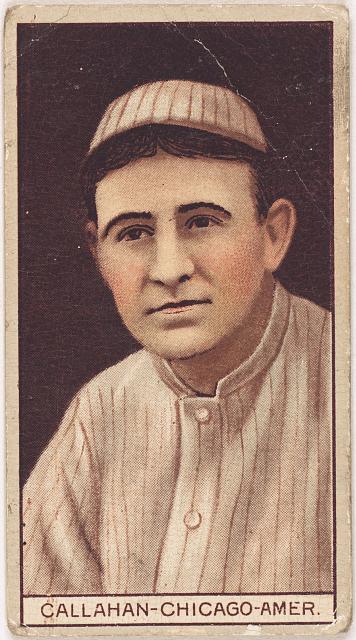 |
| Fig. 1: "Callahan-Chicago-Amer." A 1912 baseball card of "Nixey" Callahan |
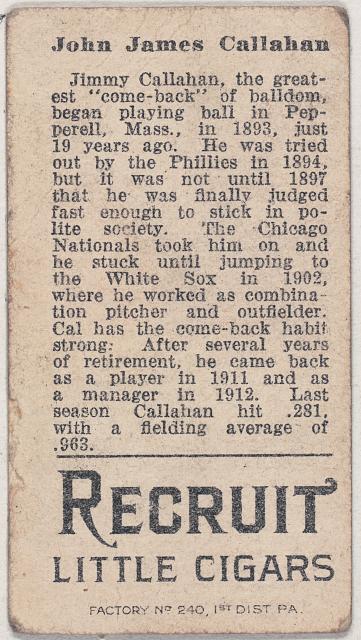 |
| Fig. 2: Backside of the "Nixey" Callahan baseball card. |
The American Memory Project of the Library of Congress has a great collection of baseball cards from 1887-1914. I found this one of "Nixey" Callahan. It is the only card of him in their collection, but there may be others.
The backside of the card reads:
"John James Callahan
Jimmy Callahan, the greatest 'come-back' of balldom, began playing ball in Pepperell, Mass., in 1893, just 19 years ago. He was tried out by the Phillies in 1894, but it was not until 1897 that he was finally judged fast enough to stick in polite society. The Chicago Nationals took him on and he stuck until jumping to the White Sox in 1902, where he worked as combination pitcher and outfielder. Cal has the come-back habit strong. After several years of retirement, he came back as a player in 1911 and as a manager in 1912. Last season Callahan hit .281, with a fielding average of .963."
New Project
After nearly three years of studying the architecture of H.M. Francis in Fitchburg, I'm moving on to a new research topic.
The work of the Francis firm will always be something I'll have a fascination in, but I feel it is necessary to begin working on another project.
Starting in May, I'm going to begin researching baseball teams in Fitchburg. Baseball was a very big part of my childhood as well as the lives of countless other young boys in America. I have very strong, emotional ties to Little League Baseball, Major League Baseball and even the minor leagues. The intricacy, chess match-like qualities of baseball have always fascinated me to a great degree. I enjoy the silence of the game. The pops of the bat, the skidding of the grass, the hurried footsteps of the batters as well as the smell of fresh cut grass, and the heat of the afternoon sun all have a special place in my heart. Through all of the events of a baseball game, the voices of the players are often subdued, and muted to spectators. You have to rely on umpire signals, player body language and dirt kicking to understand what the players go through. Today's television coverage will sometimes feature a player wearing a microphone through warm-ups or even in the dugout but those invasions taint the game for me. It's much more powerful to be a casual onlooker interpreting the grimaces and celebrations than a fly on the wall. I've attended numerous baseball games in my life, whether it's professional (Red Sox), minor league (Spinners, Sea Dogs, Paw Sox) or even amateur (Tornadoes) and no matter where my seat was, I rarely heard the dugout banter or discussions amongst players.
I much prefer that atmosphere, that wall between the spectator and athlete, the fan and the superstar.
My research is a bit open-ended at this point. I haven't devoted much time to preparing an outline towards a thesis or working goal, other to simply learn. I decided upon Fitchburg baseball because it is my current home but also because baseball at its infancy, as well as during the "deadball era" had many social and cultural implications on a community.
Two players that I want to focus on, in regards to their relationships to Fitchburg are Patrick Moran and "Nixey" Callahan.
Both grew up in Fitchburg, playing on local youth teams but later made it to the American and National Leagues.
Patrick Moran was manager of the Cincinnati Reds in 1919 when the Chicago White Sox threw the World Series and were blacklisted from baseball. It's also been said that Callahan threw the first no-hitter in the American League.
Though their major league exploits are fairly well-documented in various encyclopedias and online databases, I'm interested in seeing Moran and Callahan at a more local level before they made it to the big stage.
As the school year winds down and summer begins, I'll continue to post my research findings and get back into old grooves.
The work of the Francis firm will always be something I'll have a fascination in, but I feel it is necessary to begin working on another project.
Starting in May, I'm going to begin researching baseball teams in Fitchburg. Baseball was a very big part of my childhood as well as the lives of countless other young boys in America. I have very strong, emotional ties to Little League Baseball, Major League Baseball and even the minor leagues. The intricacy, chess match-like qualities of baseball have always fascinated me to a great degree. I enjoy the silence of the game. The pops of the bat, the skidding of the grass, the hurried footsteps of the batters as well as the smell of fresh cut grass, and the heat of the afternoon sun all have a special place in my heart. Through all of the events of a baseball game, the voices of the players are often subdued, and muted to spectators. You have to rely on umpire signals, player body language and dirt kicking to understand what the players go through. Today's television coverage will sometimes feature a player wearing a microphone through warm-ups or even in the dugout but those invasions taint the game for me. It's much more powerful to be a casual onlooker interpreting the grimaces and celebrations than a fly on the wall. I've attended numerous baseball games in my life, whether it's professional (Red Sox), minor league (Spinners, Sea Dogs, Paw Sox) or even amateur (Tornadoes) and no matter where my seat was, I rarely heard the dugout banter or discussions amongst players.
I much prefer that atmosphere, that wall between the spectator and athlete, the fan and the superstar.
My research is a bit open-ended at this point. I haven't devoted much time to preparing an outline towards a thesis or working goal, other to simply learn. I decided upon Fitchburg baseball because it is my current home but also because baseball at its infancy, as well as during the "deadball era" had many social and cultural implications on a community.
Two players that I want to focus on, in regards to their relationships to Fitchburg are Patrick Moran and "Nixey" Callahan.
Both grew up in Fitchburg, playing on local youth teams but later made it to the American and National Leagues.
Patrick Moran was manager of the Cincinnati Reds in 1919 when the Chicago White Sox threw the World Series and were blacklisted from baseball. It's also been said that Callahan threw the first no-hitter in the American League.
Though their major league exploits are fairly well-documented in various encyclopedias and online databases, I'm interested in seeing Moran and Callahan at a more local level before they made it to the big stage.
As the school year winds down and summer begins, I'll continue to post my research findings and get back into old grooves.
Saturday, September 17, 2011
Subscriber Help (Town Talk)
The publishers of Town Talk tried to make a little deal with the children of Fitchburg and Leominster in 1890.
In exchange for new subscribers the newspaper would reward the children with a gold watch or safety bicycle.
The ad reads:
"TO THE BOYS AND GIRLS OF WEST FITCHBURG, SOUTH FITCHBURG, EAST FITCHBURG AND LEOMINSTER.
We want to increase the number of subscribers in these places and will give any boy or girl a $35 SAFETY BICYCLE OR A GOLD WATCH to get us 100 subscribers for six months. The price of the paper for six months is one dollar. Every yearly subscriber will count as two. Any boy or girl can do this in a week or two. Commission will be paid for all over 10 subscribers sent in. Subscription blanks may be obtained at this office."
In exchange for new subscribers the newspaper would reward the children with a gold watch or safety bicycle.
 |
| Fig. 1: Ad posted in Town Talk aimed specifically at children in Fitchburg and Leominster |
"TO THE BOYS AND GIRLS OF WEST FITCHBURG, SOUTH FITCHBURG, EAST FITCHBURG AND LEOMINSTER.
We want to increase the number of subscribers in these places and will give any boy or girl a $35 SAFETY BICYCLE OR A GOLD WATCH to get us 100 subscribers for six months. The price of the paper for six months is one dollar. Every yearly subscriber will count as two. Any boy or girl can do this in a week or two. Commission will be paid for all over 10 subscribers sent in. Subscription blanks may be obtained at this office."
Wednesday, August 10, 2011
Your Name in a Book
(This post is part of a series about my research of Fitchburg architect H.M. Francis)
Today, I spent the majority of my time going through the Fitchburg City Directories.
 |
| Fig. 1: A picture of the main shelf of Fitchburg City Directories at the Fitchburg Historical Society. |
The directories are a great wealth of information about the residents of Fitchburg in that a person's residence and occupation are listed. It almost reads like a brief year-by-year census report without some of the finer details.
 |
| Fig. 2: Up close view of the 1942 Fitchburg Directory's spine. |
You will not find information about citizens' ages or their children and it is rare to find a listing for an unmarried woman.
The purpose of the city directory sleuthing is to confirm dates, residences and full names of the Francis clientele.
While bouncing around from one bound snapshot of Fitchburg to another, it can sometimes be frustrating to constantly look for a single answer to a single question.
 |
| Fig. 3: An open City Directory and my open notebook. |
Oftentimes, and consistent with historical inquiry: one question will only lead to more questions rather than answers. However, I believe the constant run-around and question-asking makes the answer-finding much more rewarding. The time between the question and the answer allows time for reflection, consideration, humility and reaffirmation of purpose.
For me, I know that I can never transport back to early 1900s America, but to research the lives of people who were there is very humbling. Beyond my own fascination with H.M. Francis and the buildings he designed and the architectural legacy that is now a part of Fitchburg; I am trying to tell a story. The story of H.M. Francis can only be told by he and the people who knew him. As a researcher and budding historian who is far removed from that circle, the best that I can do is tell a story about H.M. Francis.
And I intend on doing my best.
Saturday, August 6, 2011
Trip to Historic N.E.
(This post is part of a series about my research of Fitchburg architect H.M. Francis)
On Wednesday, I took a field trip to Historic New England, specifically the Otis House on Cambridge Street in Boston.
The house was designed by Charles Bulfinch and was situated in one of Boston's early elite neighborhoods.
The purpose of my visit was to view their collection of H.M. Francis drawings and add them to the inventory of known structures he designed.
Some of the highlights included:
A design for Monadnock National Bank in East Jaffrey, New Hampshire
A design for the Baxter-Whitney Mill in Winchendon, Massachusetts (see image below)
A design for a bank on Miller's River, possibly in Miller's Falls, Massachusetts
A design for a commercial block in Somerville, Massachusetts
A student drawing by Francis as well as a design for a house for Charles Harding made it into the Historic New England book, Drawing Toward Home which was published in 2010.
It was a real treat to talk to the curatorial staff at Historic New England and share in their curiosity for Francis drawings. Although Francis is often thought of as a Fitchburg-centered architect (which is true) it's beneficial and important to understand that his body of work extended past the Nashua River and into other communities.
On Wednesday, I took a field trip to Historic New England, specifically the Otis House on Cambridge Street in Boston.
The house was designed by Charles Bulfinch and was situated in one of Boston's early elite neighborhoods.
The purpose of my visit was to view their collection of H.M. Francis drawings and add them to the inventory of known structures he designed.
Some of the highlights included:
A design for Monadnock National Bank in East Jaffrey, New Hampshire
A design for the Baxter-Whitney Mill in Winchendon, Massachusetts (see image below)
A design for a bank on Miller's River, possibly in Miller's Falls, Massachusetts
A design for a commercial block in Somerville, Massachusetts
A student drawing by Francis as well as a design for a house for Charles Harding made it into the Historic New England book, Drawing Toward Home which was published in 2010.
It was a real treat to talk to the curatorial staff at Historic New England and share in their curiosity for Francis drawings. Although Francis is often thought of as a Fitchburg-centered architect (which is true) it's beneficial and important to understand that his body of work extended past the Nashua River and into other communities.
 |
| Fig. 1: Drawing of the Baxter-Whitney Mill in Winchendon, MA. Image from the American Architect and Building News magazine. |
Tuesday, August 2, 2011
Cellphone Photos, part 2
(This post is part of a series about my research of Fitchburg architect H.M. Francis)
A few more photographs from my cellphone:
 |
| Fig. 1: Entryway to the Wallace Building (razed in 1979) |
 |
| Fig. 2: Some drawings waiting to be processed. |
 |
| Fig. 3: Cover sheet to specifications for the Model Training School in Fitchburg. |
Monday, August 1, 2011
Cellphone Photos
(This post is part of a series about my research of Fitchburg architect H.M. Francis)
I was recently able to transfer some photographs from my cellphone to my computer.
I was recently able to transfer some photographs from my cellphone to my computer.
These three are some of the more recent photographs of some intriguing Francis ephemera:
 |
| Fig. 1: This is a stamp design found on many of the drawings to ensure the architect's ownership. |
 |
| Fig. 2: A small business card found amongst the drawings. |
 |
| Fig. 3: A drawing for a proposed Cleghorn school house. |
Wednesday, July 27, 2011
Nearing the End
(This post is part of a series about my research of Fitchburg architect H.M. Francis)
Today, I was able to complete the list of drawings and blueprints.
The total number of unique buildings and homes that I was able to identify was precisely 200.
Each list will be sorted by year and address before being consolidated for the overall inventory.
August will be spent cross-referencing data (dotting I's, crossing X's, minding P's and Q's) and researching more biographical information.
Today, I was able to complete the list of drawings and blueprints.
The total number of unique buildings and homes that I was able to identify was precisely 200.
Each list will be sorted by year and address before being consolidated for the overall inventory.
August will be spent cross-referencing data (dotting I's, crossing X's, minding P's and Q's) and researching more biographical information.
 |
| Fig. 1: The Francis Home on Rollstone Street (formerly Lunenburg Academy) |
Saturday, July 23, 2011
New Lamps for the Library
(This post is part of a series about my research of Fitchburg architect H.M. Francis)
In 1917, Frederick and Albert wrote to The T.F. McGann & Sons Co. in Boston to inquire about new lamps for the Wallace Library on Main Street in Fitchburg. T.F. McGann & Sons specialized in bronze and brass sculptures and was based in Boston.

 |
| Fig. 1: Letter from T.F. McGann & Sons Co. to H.M. Francis & Sons (courtesy of the Fitchburg Historical Society) |
T.F. McGann & Sons wrote back to them and enclosed four photographs of cast bronze lamp brackets that they had recently fabricated under contract with the government. They informed the Francis firm that since these were under contract, they wouldn't be able to duplicate the exact same models but they could make very similar ones.
At this time, it is unknown if these lamps graced the front of the Wallace Library but their craftsmanship is stunning nonetheless.
 |
| Fig. 2: One of the attached photographs to the McGann letter. This bracket would individually sell for $337.50 in 1917. (photo courtesy of the Fitchburg Historical Society) |
Thursday, July 21, 2011
Rounding 2nd Base, Looking to be Waved Home
(This post is part of a series about my research of Fitchburg architect H.M. Francis)
I made considerable progress today and have inventoried all of the blueprints/drawings of Francis designed homes (save for a few stragglers that found their way into other organized collections) and have begun going over the plans for commercial/public buildings.
I'm back on track to have this part of the overall inventory completed by the end of July.
When that is finished, the month of August will be spent doing things like: double-checking notes, writing a narrative, writing a bibliography, writing an accompanying guide to the inventory and maybe even
....preparing for my senior year of college.
I made considerable progress today and have inventoried all of the blueprints/drawings of Francis designed homes (save for a few stragglers that found their way into other organized collections) and have begun going over the plans for commercial/public buildings.
I'm back on track to have this part of the overall inventory completed by the end of July.
When that is finished, the month of August will be spent doing things like: double-checking notes, writing a narrative, writing a bibliography, writing an accompanying guide to the inventory and maybe even
....preparing for my senior year of college.
Tuesday, July 19, 2011
A Testimonial to H.M. Francis
(This post is part of a series about my research of Fitchburg architect H.M. Francis)
I looked through a small magazine published in 1890 called "Leading Business Men of Fitchburg."
The magazine is a well developed collection of business profiles with information about clientele and kind words of their expertise.
 |
| Fig. 1: H.M. Francis listing in Leading Business Men of Fitchburg (courtesy of the Fitchburg Historical Society) |
About Francis:
"What we particularly wish to do is to call attention to the advantages gained by enlisting the services of such an architect as Mr. Francis, when it is proposed to erect an ordinary dwelling-house; or more properly, a dwelling-house of moderate cost which will not be "ordinary." To begin with, by so doing you get a house "designed to order." It suits you, embodies your views, has an individuality of its own, and is especially adapted to the lot on which it stands...The cost of the services we have sketched is, by no means, alarming, and we have yet to learn of a man who ever repented the expense incurred by employing a really competent architect."
Subscribe to:
Posts (Atom)