Sunday, April 1, 2012

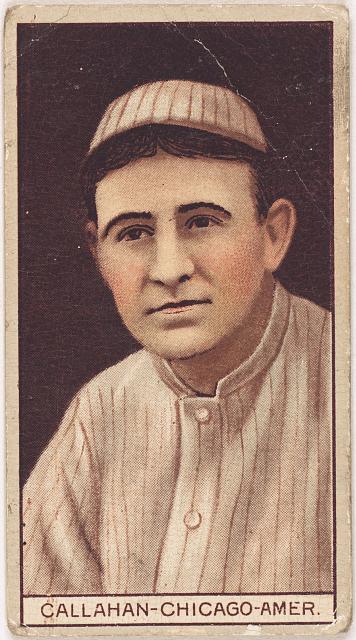
John James "Nixey" Callahan Baseball Card


Fig. 1: "Callahan-Chicago-Amer." A 1912 baseball card of "Nixey" Callahan
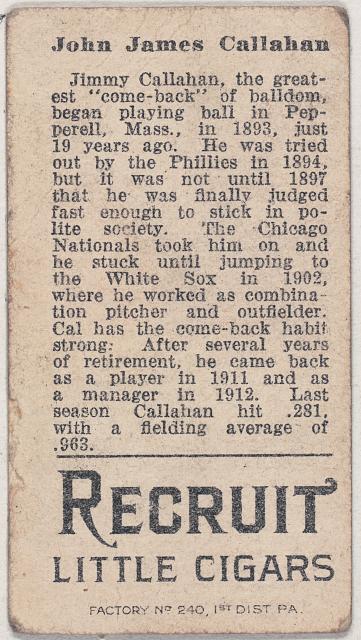
Fig. 2: Backside of the "Nixey" Callahan baseball card.


The American Memory Project of the Library of Congress has a great collection of baseball cards from 1887-1914. I found this one of "Nixey" Callahan. It is the only card of him in their collection, but there may be others.

The backside of the card reads:

"John James Callahan

Jimmy Callahan, the greatest 'come-back' of balldom, began playing ball in Pepperell, Mass., in 1893, just 19 years ago. He was tried out by the Phillies in 1894, but it was not until 1897 that he was finally judged fast enough to stick in polite society. The Chicago Nationals took him on and he stuck until jumping to the White Sox in 1902, where he worked as combination pitcher and outfielder. Cal has the come-back habit strong. After several years of retirement, he came back as a player in 1911 and as a manager in 1912. Last season Callahan hit .281, with a fielding average of .963."


New Project

After nearly three years of studying the architecture of H.M. Francis in Fitchburg, I'm moving on to a new research topic.
The work of the Francis firm will always be something I'll have a fascination in, but I feel it is necessary to begin working on another project.

Starting in May, I'm going to begin researching baseball teams in Fitchburg. Baseball was a very big part of my childhood as well as the lives of countless other young boys in America. I have very strong, emotional ties to Little League Baseball, Major League Baseball and even the minor leagues. The intricacy, chess match-like qualities of baseball have always fascinated me to a great degree. I enjoy the silence of the game. The pops of the bat, the skidding of the grass, the hurried footsteps of the batters as well as the smell of fresh cut grass, and the heat of the afternoon sun all have a special place in my heart. Through all of the events of a baseball game, the voices of the players are often subdued, and muted to spectators. You have to rely on umpire signals, player body language and dirt kicking to understand what the players go through. Today's television coverage will sometimes feature a player wearing a microphone through warm-ups or even in the dugout but those invasions taint the game for me. It's much more powerful to be a casual onlooker interpreting the grimaces and celebrations than a fly on the wall. I've attended numerous baseball games in my life, whether it's professional (Red Sox), minor league (Spinners, Sea Dogs, Paw Sox) or even amateur (Tornadoes) and no matter where my seat was, I rarely heard the dugout banter or discussions amongst players.

I much prefer that atmosphere, that wall between the spectator and athlete, the fan and the superstar.

My research is a bit open-ended at this point. I haven't devoted much time to preparing an outline towards a thesis or working goal, other to simply learn. I decided upon Fitchburg baseball because it is my current home but also because baseball at its infancy, as well as during the "deadball era" had many social and cultural implications on a community.

Two players that I want to focus on, in regards to their relationships to Fitchburg are Patrick Moran and "Nixey" Callahan.
Both grew up in Fitchburg, playing on local youth teams but later made it to the American and National Leagues.

Patrick Moran was manager of the Cincinnati Reds in 1919 when the Chicago White Sox threw the World Series and were blacklisted from baseball. It's also been said that Callahan threw the first no-hitter in the American League.

Though their major league exploits are fairly well-documented in various encyclopedias and online databases, I'm interested in seeing Moran and Callahan at a more local level before they made it to the big stage.

As the school year winds down and summer begins, I'll continue to post my research findings and get back into old grooves.
Saturday, January 21, 2012

An Undergraduate Degree (in book form)

Now that I am approaching my graduation date I wanted to take a moment to reflect on four years of undergraduate study. I was inspired by Dan Allosso's index of books to think about all of the books I've had to read in my college classes. Though one day I may expand on them as Mr. Allosso has, I figured a list would suffice for now. Thankfully, for your eyes and mine, I'm not going to list all of the articles I read from academic journals.

Perfect Spy: The Incredible Double Life of Pham Xuan An, Time Magazine Reporter and Vietnamese Communist Agent by Larry Berman


My First Summer in the Sierra by John Muir


West of Everything: The Inner Life of Westerns by Jane Tompkins


Vietnam: A Portrait of Its People at War by David Chanoff


The Virginian by Owen Wister


The Indian Frontier of the American West, 1846-1890 by Robert Utley


The Challenge of Rethinking History Education: On Practices, Theories and Policy by Bruce VanSledright


Women's Diaries of the Westward Journey by Lillian Schlissel


Ho by David Halberstam


Sugar Creek: Life on the Illinois Prairie by John Faragher


Lies My Teacher Told Me About Christopher Columbus: What Your History Books Got Wrong by James Loewen


Doing Comparative Politics: An Introduction to Approaches and Issues by Timothy Lim


Major Problems in the Era of the American Revolution, 1760-1791 edited by Richard Brown


Dark Continent: Europe's Twentieth Century by Mark Mazower


The River Runs Salt, Runs Sweet: A Memoir of Visegrad, Bosnia by Jasmina Dervisevic-Cesic


The American Revolution: A History by Gordon S. Wood


The American Presidency: Origins and Development, 1776-2007 5th edition, Sidney Milkis


A Pocket Guide to Writing in History by Mary Lynn Rampolla


A Writer at War: Vasily Grossman with the Red Army, 1941-1945 by Antony Beever


Make No Law: The Sullivan Case and the First Amendment by Anthony Lewis


Benjamin and William Franklin: Father and Son, Patriot and Loyalist by Sheila Skemp


Good-Bye to All That: An Autobiography by Robert Graves


Wartime by Paul Fussell


After the Fact: The Art of Historical Detection by James West Davidson


The Lexus and the Olive Tree by Thomas L. Friedman


Up the Down Staircase by Bel Kaufman


Ama by Manu Herbstein


Electroboy by Andy Behrman


The Sea Captain's Wife: A True Story of Love, Race and War in the Nineteenth Century by Martha Hodes


Standing at Armageddon: The United States, 1877-1919 by Nell Irvin Painter


Women and Slavery in the French Antilles, 1635-1848 by Bernard Moitt


Mastery, Tyranny and Desire: Thomas Thistlewood and His Slaves in the Anglo-Jamaican World by Trevor Burnard


The Alcoholic Republic: An American Tradition by W.J. Rorabaugh


Becoming America: The Revolution Before 1776 by Jon Butler


Disposable People: New Slavery in the Global Economy by Kevin Bales